What it's like to have the machine that keeps you alive die while you're on vacation
I'm about to tell you a story about the major disaster which affected much of my decisionmaking on my week-long vacation to Santa Fe. I just got home to LA, and the situation is now resolved. But it was super fucking annoying!!
I didn't mention it in any of my other posts because I was waiting to learn how it would actually resolve.
I know a lot of people whose lives depend on access to medicine. I know fewer other people whose lives also depend on the machinery and software used to dose that medicine. Insulin pumps, pacemakers, and other crucial, always-on medical equipment are crazy useful but also contain the possibility for insane frustration and resentment. I've been pretty honest over the years that I value having an insulin pump, but that I also hate the manufacturers and designers of every pump I've ever used. If you introduced me to any person who has ever designed an insulin pump I've used, I would probably punch them in the face and cuss them out in front of their children. Every single pump I've used as caused me massive problems - though none as bad as the one I'm about to describe.
It is not possible - for me, anyway - to have a neutral, positive relationship with the machinery that keeps me alive. Every problem it has is an indignity and an insult to me. Anything it does that irritates me is a sin. Universal healthcare would make my life easier, for sure. But the irritation I feel whenever I have to deal with a pump problem will never go away until diabetes is cured.
Until then, the people who design, sell, and service these machines are both keeping me alive and also my mortal enemies. I think that this is an inherent effect of being dependent on a tech company to stay alive. You can treat the following story as a window into what that experience is like for a patient.
If you work for the company that made the pump I'm about to complain about: I fucking hate you, and I hate your pump. This is the deal you made when you decided to make machinery that keeps me alive.
There's no way out of it for either of us; it's just the dynamic we're trapped in.
Though I'm trapped in it much more than you are, aren't I?
How diabetes works
I have type 1 diabetes - the type of diabetes you get when your pancreas stops making insulin entirely. It's also called "juvenile diabetes." T1 diabetes cannot be controlled with diet or lifestyle changes - it can only be controlled by taking insulin injections multiple times a day.
Type 1 diabetes is "insulin dependent." If you don't have the insulin, you sicken and die. Going without insulin for even a few hours can make you very ill. You'll need both a basal dose of insulin acting on you 24/7, as well as bolus doses to cover the digestion of any food you eat. Insulin performs a kind of last-step role in the digestive process - it's the hormone that allows your cells to absorb energy, in the form of sugar, from your bloodstream. So running out of insulin is a Bad Time.
How my pump works
To get insulin into my body, I use an insulin pump paired with a continuous glucose monitor. My pump is a Tandem tslim X2, and my CGM is a Dexcom 6 (though I have to swap to the Dexcom 7 this month, because Dexcom is ceasing production of the older model I use). The Dexcom checks my blood sugar every couple of minutes all day long. It sends this information to my pump, which then decides whether to give me my regular dose of insulin, a lowered dose, or a higher dose. If my blood sugar is too low, I get less insulin; if my blood sugar is too high, I get more. I also have to tell the pump when I'm eating, so I can get that "bolus" dose to cover my food.
Every time I go on vacation, I have to ensure that my pump keeps running so I can stay alive. I do this by bringing about two times the number of supplies I need for the time I'll be gone. Supplies for my pump include not only insulin but also the disposable plastic medical waste my pump generates - in this case, the needles and tubes that connect my body to the pump. My pump has a disposable plastic cartridge that holds the insulin, a disposable tube that goes into my leg or torso, and a disposable quarter-inch metal needle that sits inside my skin all day long, held in place with a sticker patch.
I also need a big nasty syringe to inject insulin into the cartridge - I suck insulin out of the vial with this giant syringe, then inject it into my pump like I'm performing some kind of science experiment. It makes me look very Frankenstein if I have to do it in a restaurant.
Preparing to go into the desert
I'd be gone in Santa Fe for about seven days, so I brought about fourteen catridges and around twenty of those big-ass needles. I brought about ten or twelve "pump sites", the needle that goes into my skin. I brought two entire vials of insulin, which should be something like seven or eight times the amount of insulin I'd need. I felt that I was being very redundant.
Foolishly, I did not bring the backup-of-the-backup. I never have! I've never had my pump actually fail on me. I've been using pumps since I was in sixth grade, and it's never happened before once in my entire life. So!!!! If you're trying to choose between Minimed - which I used for nearly 20 years - and Tandem, which I use now... let this be a point of data for you!
For me, the back-up-of-the-backup would be an insulin "pen" injector containing a long-acting insulin. The insulin in my pump takes effect in less than 15 minutes, but the insulin in my backup pen slowly acts on me over the course of 24 hours. So if you take a shot from the pen every day at the same time, it has the same effect as an insulin pump would have. Instead of getting tons of tiny doses per day, you get one big slow dose. This is reliable, but less safe than the pump. You can turn a pump off if you're having a low blood sugar emergency, but once you take the shot from the pen, you're stuck with that dose for the next 24 hours.
To tell the truth: I do not even know how to use the pen. I have never needed to do this in my life.
I've lived with diabetes for 27 years and I've been on pumps for 25. I have spent a quarter of a century relying on machines to keep me alive. It has never failed on me before. It's incredible that I've been able to do this, and it's incredible that it never occurred to me to plan for a situation where the entire pump would fucking break. We can thank the FDA for that!
The machine that keeps me alive breaks down while I am on vacation
Anyway, it was only a couple days into my trip when my pump sent me this ominous message:
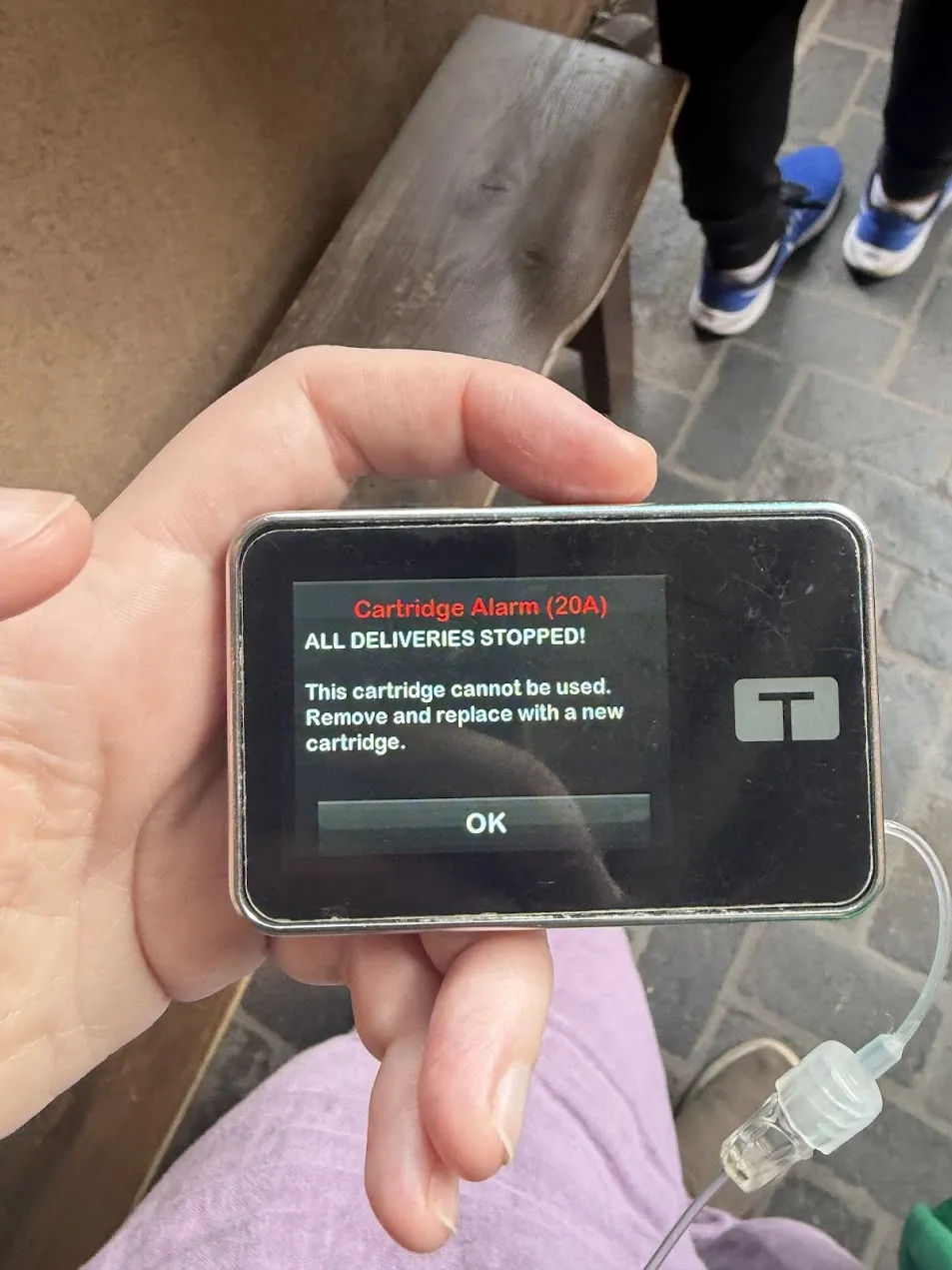
CARTRIDGE ALARM 20A
ALL DELIVERIES STOPPED!
This cartridge cannot be used. Remove and replace with a new cartridge.
Wow! That looks serious! I took it at face value and replaced my cartridge.
Because I am a bozo, it did not occur to me to try and suck the insulin out of the cartridge when I replaced it. I usually only replace my cartridges when they are completely empty, so I'd never before thrown out a bunch of insulin when I threw out a cartridge. Idiotically, I think I threw out about 40 units of insulin when I threw out this cartridge. That's about a third of the total amount of insulin in the thing.
You are not supposed to suck insulin out of your pump and put it in a new cartridge. That's bad! But If your pump fails on you 10x in one vacation, you might end up doing that to economize on the amount of insulin you're losing. I did this a couple times before realizing that the cartridges were fine and I could just ignore what the pump was saying.
Another thing - the Tandem tslim X2 requires the user to "prime" the pump tubing with 10 units of insulin every time the pump shuts down or the cartridge is replaced. This is by far my least favorite, most hated thing about this pump. If I am dumb enough to let my pump run out of batteries, I then waste ten units of insulin starting it back up. It's insane. Insulin is expensive; there should not be cover-your-ass lawyer-flavored features which require me to waste ten units of insulin any time I do anything unexpected with this pump. (Long before my pump failed, this specific feature had convinced me to stop using Tandem pumps the next time my insurance lets me change brands.)
So: When I replaced this first cartridge, I not only wasted the 40 units I threw out, but also the 10 units I used to "prime" the pump tubing with to set up the new cartridge. For me, that's more than one entire day's worth of insulin.
It happens a ton more times
This same error happened again two days later. I was already extremely mad about wasting 20 units of primed insulin across two cartridges, so I looked the error up online.
I immediately found this reddit thread, which explained to me that the pump itself was failing. I decided that if it happened one more time, I'd call Tandem.
I was still replacing my cartridge every time I got this error, because I took the error at face value and supposed that the cartridge itself was busted. It was not. I didn't know it at this time, but I could have followed this procedure to get the pump functioning temporarily again every time it failed:
- Wait 10-15 minutes without insulin
- Remove the cartridge and immediately snap it back in
- Re-"load" the cartridge and prime out 10 units
This worked very reliably. The problem wasn't the cartridge; it was the pump. But for the first 5 or so times I got this error, I obediently replaced the cartridge. I wasted a fuck ton of cartridges this way.
A sequence of failed problem-solving
The third time I got the cartridge fail error, I was at a museum in Santa Fe with my husband. I immediately made us drive back to the hotel, where I called Tandem customer service and learned that my pump was indeed failing and would need to be replaced.
The call with customer service was illuminating but also frustrating. When I was in middle school, I used a pump called a Disetronic. I dimly remember getting an error code, calling it in (the pump was still functioning!) and having a woman literally drive to my house with a replacement pump for me. I lived in Connecticut, rather close to multiple different major population centers, so maybe I was just lucky... but it seems that pump companies no longer do this kind of thing at all, now that overnight shipping exists. They just mailed a replacement pump to my house, even though I wasn't located there.
Admittedly, I did have an opportunity to cause a fuss which I did not choose to take - mostly because I still assumed the situation was fixable. The woman on the other end of the line asked me, "Do you have a plan to continue your insulin pump therapy?" I said, "I guess. I will have to call my doctor and get my prescription for long-acting insulin moved to a pharmacy in Santa Fe." I don't know what she would have done if I'd said "no." I am also not sure what would have happened if I had started a fight over the decision to overnight the pump to my home. I might have been able to get it overnighted to the hotel if I was a big enough bitch about it.
Dealing with medical companies, however, makes you very eager to be compliant. I was definitely trying to cruise through this situation without causing waves or getting weird treatment from the company that literally keeps me alive. We have, as you might imagine, a weird power imbalance.
But immediately after this, my desire to be compliant led to me making an even bigger screwup. A few years ago, I began using my hospital's online messaging system to contact my doctors. It's usually faster than calling because multiple people associated with each office watch the incoming messages. If I can't get ahold of a doctor, a nurse is usually able to sort me out. It also allows me to send a long, detailed, precise message, then get a reply which is more specific, accurate, and reliable than a phone conversation usually is.
So I sent in a message containing the address of the pharmacy closest to me in Santa Fe, a request for them to send a long-acting insulin pen refill there, some details about my pump failures, and some questions about things I could do to mitigate the issue. Then I crossed my fingers and hoped someone would see it over the Memorial Day holiday weekend.
What I didn't know is that my diabetes doctor's office actually still has a on-call contact system for urgent-but-not-emergency issues which is still phone-only and does not interface with the messaging system at all, just like it did twenty or thirty years ago. The main reason I didn't know this on-call phone number existed is because there is no messaging about it anywhere on the hospital website. They just tell you to go to the emergency room!
Over the course of that Friday and the following weekend, my pump started failing about once every twelve hours. I started counting cartridges. I drew a line on the calendar and told myself: if I can't figure out what to do before this time exactly, I'll go to the emergency room.
This was dumb of me. I should have caused a bigger fuss. If I'd bitched to more people and made more phone calls and hit 0 on more phone trees, I probably would have alighted on the solution of the endocrinology on-call number, or gotten the pump overnighted to my location, or shortcut this entire process for myself. In my defense, I was trying to not be a problem. I am very bad at knowing when I need to start being a problem over my medical stuff!
I do think that it is significant, however, that when I told the pump company I wasn't at home, they didn't offer to send it to where I actually was. There wasn't a serious attempt to connect me to a pump as quickly as possible - just regular shipping addresses, formal processes, and a series of scripted rules they read out to me about returning the pump. They were more concerned with telling me that I'd be billed for the old pump if I didn't return it.
I was also very headstrong about not going to the emergency room. I know that going to an emergency room would have cost me an insane amount of money, and would have taken me hours to get to what I already knew was the solution: a simple long-acting insulin pen prescription. It would ruin my vacation, create months of paperwork followup, and cost me a ton of money while I am already unemployed. And for what?? I was still able to get the pump restarted every time it broke, wasn't I?
What it's like to drive all over northwest New Mexico with a failing insulin pump
I decided to not change our plans for the next few days at all. We'd counted on going to Bandelier National Monument, the Earthship Welcome Center near Taos, and a couple other places that were an hour or more from Santa Fe. I decided that we could continue doing all these things if I just carried all my medical equipment with me everywhere we went. If the ultimate solution was "go to the emergency room," we would never be more than an hour from the emergency room, and it would take much more than an hour for me to genuinely be in danger if my pump failed. Staying in Santa Fe didn't seem necessary.
We already had a cooler in the back of the car at all times, so I loaded it up with my insulin and threw a bag containing all my backup medical supplies in the car. And, like clockwork, my pump continued to fail once or twice a day, usually more than twelve hours apart. I wasted an extraordinary number of cartridges and many units of insulin.
Every time it happened, I did worry that my pump would fail to restart and I'd be stuck driving directly to the closest emergency room. I am very lucky that it continued to restart and that the risks I was taking didn't cause me any serious problems at all. My blood sugar was under control, and the pump was mostly working. It was just really, really annoying to deal with the moments when it wasn't!
Monday afternoon, I finally got a call from my doctor's office. They sent a new prescription for long-acting insulin to Flagstaff, where I'd arrive early the next day on the first leg of my drive home to LA. I was relieved. I was even kind of excited to use a pen for the first time, and to be without a pump on my body for the first time in nearly 30 years.
Nobody in the high desert has any long-acting insulin
This post is going on for too long already, so I'll cut to the chase:
- Flagstaff did not have any insulin for me. They were out. There was no available long-acting insulin anywhere between my hotel and Sedona.
- The CVS search system does not allow users to search for their medication in any pharmacies more than 25 miles away.
- Astonishingly, this function isn't available to pharmacists either!!!!!! According to the guy from the Flagstaff CVS who called me, they can either search for your medication within the nearest 25 miles, or send your prescription directly to a specific pharmacy.
- I was continuing to drive across the southwest to Los Angeles, because my replacement insulin pump was due to arrive there today, Wednesday, the day I returned. So it made no sense to hunt for insulin anywhere between Flagstaff and LA. I could just drive home to LA directly.
- Once I was in CA, I assumed that my insurance situation would probably get easier, too - I am on a California ACA exchange plan. I would be much happier going to an emergency room in California than in any other state.
So this meant that I spent two days longer than I expected with a broken insulin pump. Again, I experienced no negative consequences from this whatsoever. I just drove directly home, found the new pump sitting in front of my door, and got everything sorted out. I did have to re-prime the pump one last time - Wednesday morning at 3 AM - but that was merely extremely annoying. Medically, I am absolutely fine. This was probably a bad lesson for me to learn.
The funniest thing, however, is that my local pharmacy in Los Angeles does not have any long-acting insulin available either. I really have no idea what to think about this. The fact that nobody could get me the damn insulin once I had the prescription is possibly even more frightening to me than the pump failure. I can't help but wonder if the plan I told the customer service rep over the phone was idiotic from the start.
It's possible that even if I threw a fit on every phone call, the only place that could have given me insulin was the place of last resort - a hospital where they would have been able to inject me with long-acting insulin in the emergency room. But how was I to know?
What have I learned
If I don't write what I've learned here, one of those hideously irritating diabetics who goes on Reddit and argues about everything from the perspective of Perfect, Unerring Care will send me an email criticizing me. Fuck you, if that's you. If you were even thinking of emailing me to criticize me about what I did, I hope you die. Of diabetes.
Here's what I will do:
- Bring an insulin pen with me the next time I go on vacation.
- Put the on-call number in my phone.
That's it. I will probably also be meaner to everyone who gets me on the phone in the future during an emergency. I was trying specifically to not do that, but I suppose it's helpful to be mean when your medical equipment is failing.
Everything is good now. Everything is great.
So I escaped this extremely risky and stupid problem - partially of the pump's making, partially of my own creation - with zero consequences other than the fact I had to prime out 10 units of insulin once or twice a day for about a week. I got home today and now have a new insulin pump which is identical to my old one. It works great. It continues to keep me very healthy and safe.
I hope that you can understand why - even when I made the situation worse by not throwing a big enough fit - I held in my heart a deep and powerful crystallized unit of blame for the pump company, and the pump company alone. I gotta say it again: my previous insulin pumps never broke. Not a single one of them ever stopped giving me insulin.
It's very difficult to have a normal attitude about a tech company that keeps you alive, but it's even harder to be normal about it when the tech fucking breaks. Even if we lived in a utopia, with universal healthcare, universal pharmacy medication searches, and helpful customer service reps who send backup pumps directly to my location on the backs of swift eagles... even then, I don't think it's possible to live without resentment for the technology keeping you alive.
Somewhere in the back of my head, something is always screaming: it's fucking stupid that I have to do this at all!!