How Skin Deep feels like Blendo
I read this post by Christian Donlan from Eurogamer several months ago. It's a reflection on how thrilled the writer was to play Skin Deep and to recognize the Blendo artistic voice inside it.
The games industry often feels very lacking in specific creator voices that evolve and grow over time. There's plenty of these to find in indie - Play a game by creators like thecatamites, increpare, Sylvie, Talha & Jack, or Analgesic Productions and you can very easily identify an artistic voice that has grown, complicated, and expanded over time. But AAA development processes tend to obscure creator perspective and voice to the point where individual, singular perspectives are undetectable.
Because this clarity of voice is lacking in our industry's biggest and most expensive products, I think it makes us more preciously value the smaller creators who express coherent voices. But some people seem to believe that a voice like this comes merely from the indie nature of those smaller productions. This isn't true - voice consistency is a choice, and you have to do very specific things with your craft and your team communication to achieve it at any scale.
There's a tendency to romanticize this kind of thing. I'm not saying that Donlan has, but the admiration he expressed about the Blendo voice made me want to explain how a persistent voice like that even happens - and how it persists when the makeup of the team changes.
Hitting a "house style" with a team requires analysis and deliberate imitation. This is very technical work which requires a high degree of self-awareness, a good amount of emotional insight, and a strong ability to communicate. The ability to adopt and expand on a house style is, I think, the most difficult, senior-level skill you can possibly express while working on a creative team.
And I really, really enjoy doing it!
Starting with Documentation
To kick this off: I originated the story of Skin Deep. Brendon told me that he wanted a story about an "insurance commando," described the job to me, and then asked me to come up with the plot. I was the one who chose Nina as the protagonist, chose the evil twin narrative, chose the plot beats, etc. I pitched them back to Brendon for approval.
I was specifically choosing characters and plots that I believed "felt like Blendo". I got a sense of what "feels like Blendo" not only by playing previous Blendo games, but by watching, reading, and playing Brendon's influences.
This was made easier by the fact that I am married to Brendon and have complete access to him at all times! I could just ask him, "Have you ever seen this movie? What did you think of it?" We were together for five years before I started making games with him, and six years before I started earnestly writing the script to Skin Deep, and in that time we watched tons of movies which I was able to accurately identify as "Brendon-core." We'd watch something together and then discuss the degree to which it had influenced his previous work, or it reflected the kind of art he wanted to be making.
Some of the influences we discussed include:
- The Adventures of Buckaroo Banzai Across the 8th Dimension (1984)
- Mismatched Couples (1985)
- Brazil (1985)
- Die Hard (1988)
- The Killer (1989)
- Days of Being Wild (1990)
- Hard Boiled (1992)
- Chungking Express (1994)
- Grim Fandango (1998)
- In the Mood for Love (2000)
- Run Lola Run (1998)
- The One (2001)
- Speed Racer (2008)
- One Cut of the Dead (2017)
- Malignant (2021)
- The Venture Brothers
Not all of these were even things Brendon independently recognized as an inspiration to his work. Others were valuable not because they were similar to Skin Deep, but because they inspired good conversations between us about what he wanted from the game. Brendon is very good at discussing what specifically he admires in a work of art that he likes. Though it's not at all similar to Skin Deep, talking about what we both liked in Malignant was incredibly helpful for me - it provided a perfect lens for us to discuss what kinds of "on-the-nose" media we appreciated, what kind of comedy we liked, or what kinds of tone thrash we desired.
While we were watching all this stuff, I was preparing to write guiding documentation for myself and others about the core identity of the Blendo setting. In a group creative setting, I believe that you can never get by on just vibes. You need to be able to communicate your goals for your setting, your characters, and your story in clear, specific language. This does not strangle creativity. It does not suppress spontaneity. It creates a shared foundation from which you can all begin to reach for those things.
For me, it also creates a kind of psychological safety in the creative process: a confidence that we're all on the same page, beginning from the same place, and that we're vocal and precise enough to discuss creative issues together without rising into a state of unpleasant conflict.
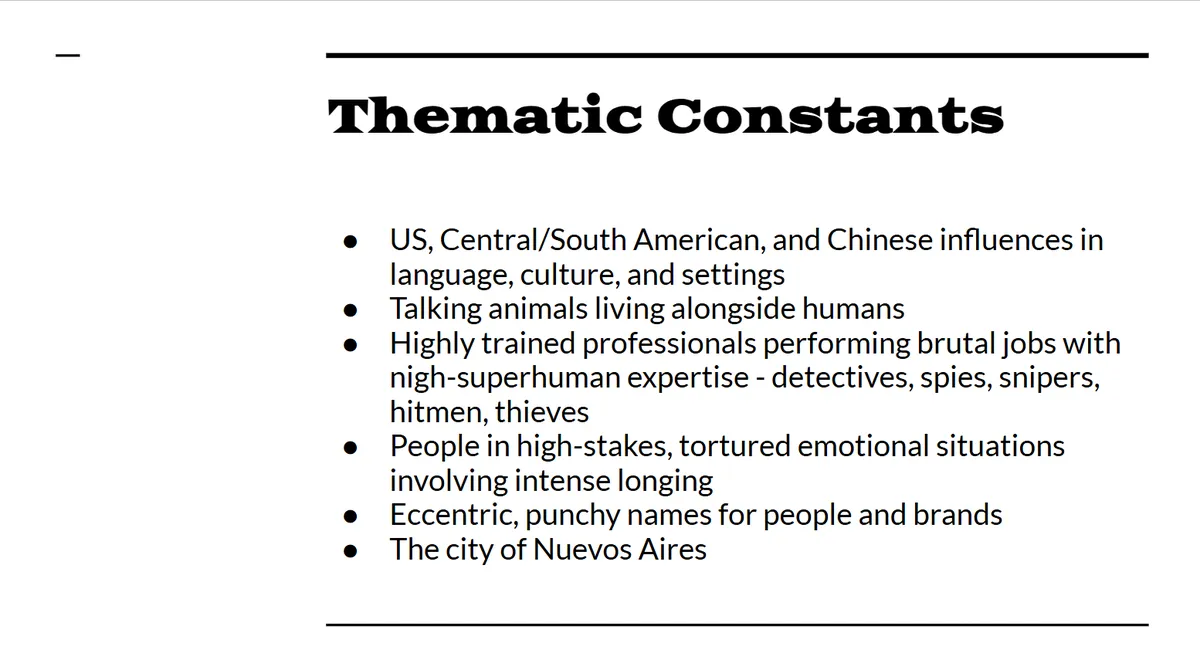
So I sat down and summarized some extremely high level ideas that I thought characterized the Blendo setting of Nuevos Aires. This was the summary I landed on:
Thematic constants
- US, Central/South American, and Chinese influences in language, culture, and settings
- Talking animals living alongside humans
- Highly trained professionals performing brutal jobs with nigh-superhuman expertise - detectives, spies, snipers, hitmen, thieves
- People in high-stakes, tortured emotional situations involving intense longing
- Eccentric, punchy names for people and brands
- The city of Nuevos Aires
After passing this by Brendon to make sure it struck a chord with him as well, I then took the entire list of all brands, people, and locations in the "Blendoverse" - a list he'd had to make in order to define his "IP" and arrive at contract terms with our publisher - and pick out the ones that were best examples of the language, jokes, and cultural influences he liked to use in his material. I wanted a neat and tidy, sharable example of "what Blendo games feel like", so we couldn't just share the full list. We needed representative examples.
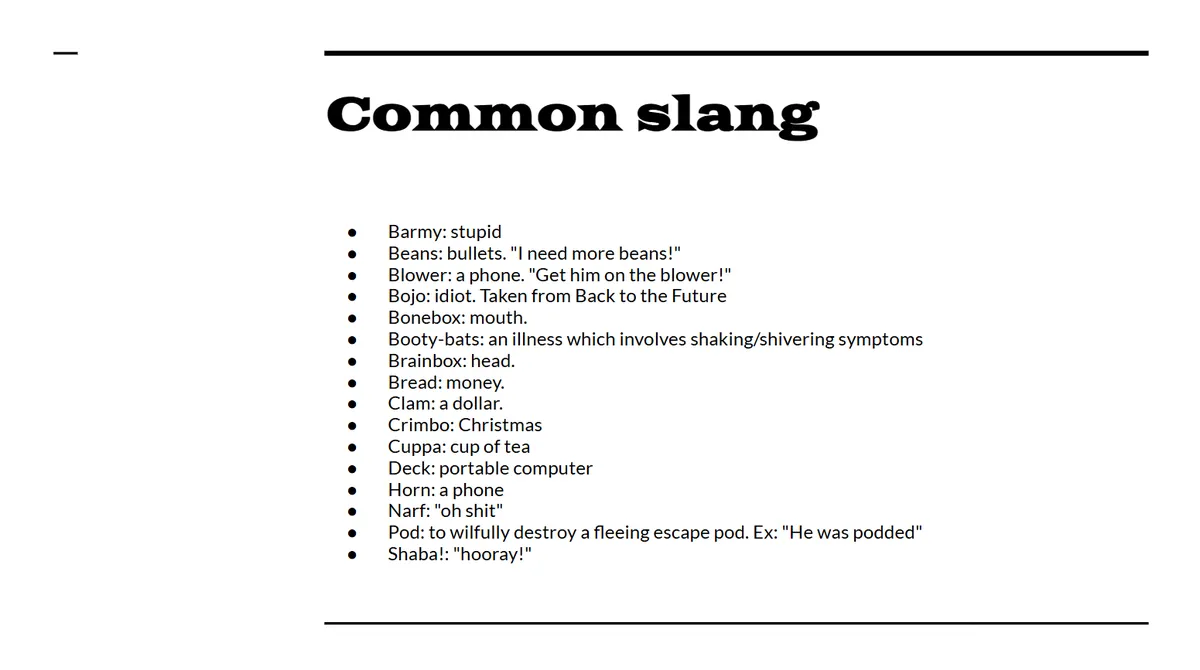
We also had to identify all the slang he'd had characters use in previous Blendo games:
Common slang
- Barmy: stupid
- Beans: bullets. "I need more beans!"
- Blower: a phone. "Get him on the blower!"
- Bojo: idiot. Taken from Back to the Future
- Bonebox: mouth.
- Booty-bats: an illness which involves shaking/shivering symptoms
- Brainbox: head.
- Bread: money.
- Clam: a dollar.
- Crimbo: Christmas
- Cuppa: cup of tea
- Deck: portable computer
- Horn: a phone
- Narf: "oh shit"
- Pod: to wilfully destroy a fleeing escape pod. Ex: "He was podded"
- Shaba!: "hooray!"
The funny thing about these documents is that we were not trying to make something that the team would often use. Most people on the team worked directly with Brendon and learned about his creative goals from him directly. It was not the goal of this documentation to replace their relationship with Brendon.
Instead, the goal of this particular document was primarily to experience the document-creation process itself. Making the document forced us to agree on a tone target together and learn how to speak it out loud. Once we finished, I knew what Brendon wanted, and he knew what my plans were, and we were both equipped to go communicate those goals to other people on the team - he to the level designers, and I to the writers who wrote the cat emails.
Something else you should know: I had spent the previous three years of my life working in IP documentation at Riot Games. So I had preexisting experience interviewing game devs about their influences and goals, choosing creative inspirations to hold up as a target or an example, and then recording all those goals in easily-sharable documents. Doing that had been one of my main jobs at Riot for years.
I don't think you need this level of experience to create good creative documentation. You need the right priorities, and you need to be honest with yourself about how the document will be used, and by whom. You need to decide whether it's there as something you're going to be reading a lot, or whether making it is more about the process than the outcome.
How to imitate your friends and loved ones
After all that, I had to sit down and write in an imitation of Brendon's voice.
If I were teaching a writing class for teenagers or college students, I'd probably make them imitate someone else's writing style as an exercise. I'd probably make them do this several different times, for a range of different historical and contemporary styles. I'd want to liberate them from the idea that writing is only about expressing the self.
My writing classes in school spent way too much time asking students to find "their own" voice, often in a way that left little room for failure or vulnerability. The constant pressure to identify your homework assignments with your soul - while simultaneously pleasing the teacher! - felt dishonest to me. I was very lucky to have teachers who sometimes let me "explore my voice" by writing something that rejected the premise of the assignment entirely!
When I learned that it was perfectly acceptable for me to write pastiche, I was delighted. It's funny to write a conspiratorial letter-to-the-editor, a silly noir mystery, or your own homemade Icelandic saga poem. I love writing an entire story in the voice of a person whom I think is stupid. Writing can be a kind of performance in the same way that acting or improv theater is. Your writing does not have to represent some deep part of your soul all the time. Tone and style are tools. They do not emerge naturally from the heart. They are an expression of your craft skill.
The most useful class I took in college was a poetry class where the final was a test with 100 different 20th century American poems I'd never seen before. I had to identify the precise author of every single one of them in about two hours. The entire class was set up to teach this test specifically, and the professor was clear from the beginning that we'd succeed on the test only if we learned the identifying hallmarks of entire creative scenes, then memorized who worked in each scene and how they differed from one another. I got a 100 on that test not because I'm particularly clever, but because she provided so much clear - and diagrammed! - analysis of how different 20th century artistic movements influenced and offended one another.
This taught me more than anything about how to describe another person's writing - which, in turn, made me a lot better at replicating someone else's style.
If you want to get better at imitation, I can really only recommend doing your own version of this: reading a fuck ton, talking about the material with someone, and checking out the material's context. If you know why people were writing a certain way at a certain time, you can imitate it a lot more easily!
Choosing a Blendo scenario
On Skin Deep, Die Hard was our biggest reference. We didn't have to study its context particularly hard - it's easy to learn about the circumstances that created the machismo of 1980s action films. We'd lived through its impacts ourselves as children and were deeply familiar with the genre.
We needed a protagonist who expressed the aggressive meathead sensitivity of movies like Die Hard. Someone with poor emotional insight, a very primal personal need, a deep personal regret driving them to self-destructive impulsivity... and a lot of reasons to be a chatterbox, so that they could drop one-liners. And we didn't want to just slap a Bruce Willis imitator in here! That would be too easy, and taking the too-easy way through a story does not feel sufficiently eccentric to be "Blendo".
I selected Nina Pasadena from Flotilla specifically because I could so easily imagine how we'd transform her into a kind of girl meathead appropriate for an 80s action movie pastiche. I wanted someone head-empty, sad, angry, but also capable of growth, and easy to root for. Ex-assassins are great for these kinds of stories. Someone who regrets violence, but must return to violence to protect her friends?? There's nothing better for an action movie pastiche than that!
I wanted Nina's personal problems to be simultaneously very primal and very eccentric. Having an evil clone fulfilled this - I can't remember when specifically I came up with the idea, but I selected it because it's the kind of personal problem that is both very silly and very illuminating of a character's personality.
It is not the kind of thing that happened much in 80s action films, mostly due to technological limitations in filmmaking. However, we'd previously watched the 2001 Jet Li evil clone movie The One, which is insanely good-bad, very silly, and perfectly meathead in every imaginable way. (Spoilers, but check out the final fight here.) I knew we could hit something like "The One, but girl" very easily with Skin Deep.
Doing all of this required us to have a shared understanding of what was "the correct amount of silly" for a story like this. This was where our thematic constants were the most useful - we knew that we could crank up the silliness as hard as possible, so long as it was in service of those constants. For example, we could accept any silliness that made our characters seem more like lonely, superhumanly-skilled, violent technicians. Snipers, hitmen and thieves! We also knew we could accept silliness in service of tortured emotions - in this case, loathing yourself, loathing your past self, hating your future self, and so on.
Another point of agreement we shared was that stories should, to whatever extent possible, contain the entire scope of human experience. This is something I've written about on this blog before. It's a personal preference that Brendon and I both share. We love stories with aggressive tone swings, emotionally-clashing twists, and chaotic plots because we love it when sincere and absurd storytelling is juxtaposed. We believe that things are funnier when they are next to things that are serious, and that serious moments hit better when we arrive at them from a moment of absurdity.
I'm fully aware that this is a personal preference and not a hard line recommendation for writers in general. It's a type of storytelling that Brendon and I both enjoy and feel good at, so we've adopted it as a rule.
Nina's problems are quite serious - self-loathing is no fun - but they're presented in an absurd way, and her support group is all talking cats. Talking cats have been a long-running part of the Blendo IP, and I felt that giving them a central role in this story would help to achieve a "Blendo" level of eccentricity and tonal thrash. Brendon agreed.
Hitting the Blendo tone in dialogue was fairly straightforward once we set these goals for ourselves. Not many Blendo games have heavy dialogue, and none have VO, so I had room to explore this space myself. In combat, I heavily prioritized dialogue that sounded like corny 80s action movie one-liners. In narrative scenes, I prioritized dramatic, overwrought, comic-booky conversation - I wanted this to feel very pulpy. Brendon's previous work is extremely pulpy, though somewhat more tempered with conventions borrowed from drama by filmmakers like Wong Kar-Wai. We deliberately wanted Skin Deep to feel more silly and frivolous than those games, so there was some tone difference here.
Everyone must have done this
Something I cannot speak to in this post is how the rest of the team analyzed and hit the "Blendo" voice target in their own work. This is a core tension in game development! You are working with a lot of people who can't tell you how to do your job, and can't help you choose how you will solve your problems.
Brendon is an uncommonly multidisciplinary developer, but many of us on the team were exercising skills that he does not have. If you sense a unified voice in any team-built game, you are sensing not only the impact of leadership, but also the skill of its individual contributors.
They are the ones who choose, for example, what "the Blendo voice" means to their work.
Here's some of my documentation
For the last year I've wanted to release some of the narrative planning documentation we made for Skin Deep. I wrote this post in part to force myself to do that.
The presentation I screenshot above is here. It was created primarily so that we could experience its creation. It was also very useful for me when communicating with external writers and with our publisher.
You will note that it's distinctly unfancy and that it's over-concerned with background information that does not appear in the actual plot of Skin Deep. This material exists to help create the image of Nina Pasadena in the reader's mind. It didn't always inform the actual line by line choices I made in the game writing, and the final version of the game actually contradicts it in some places. Because I was not sharing the main plot with another writer, I was free to make changes to the story mid-development without updating the documentation.
I'm glad to field any questions about this material from games writers in my email. However, I don't recommend that anyone copy the format of this document, and I won't defend anything I did here as "how you should do it" or "a good example of what you should do." You should be creating your narrative documentation as a group with your team, and it should primarily focus on solving the problems you have on your project!
I hope to later release more documentation related to the actual writing process itself. I worked in both spreadsheet and screenplay format and have various versions of the game plot outline saved as well. I hope I get around to that soon!