Here's an invasive plant: castor bean
I thought it might be interesting to tell you about various invasive plants that are common where I am... and probably where you are, too.
Castor bean, Ricinus communis, is a bush/tree that, more likely than not, is probably somewhere near you right now. It seems to be where most people are - it's all around the Mediterranean, all over India, southern China, Southeast Asia, much of Africa, Australia, and all over both South and North America. Here's the iNaturalist distribution map:
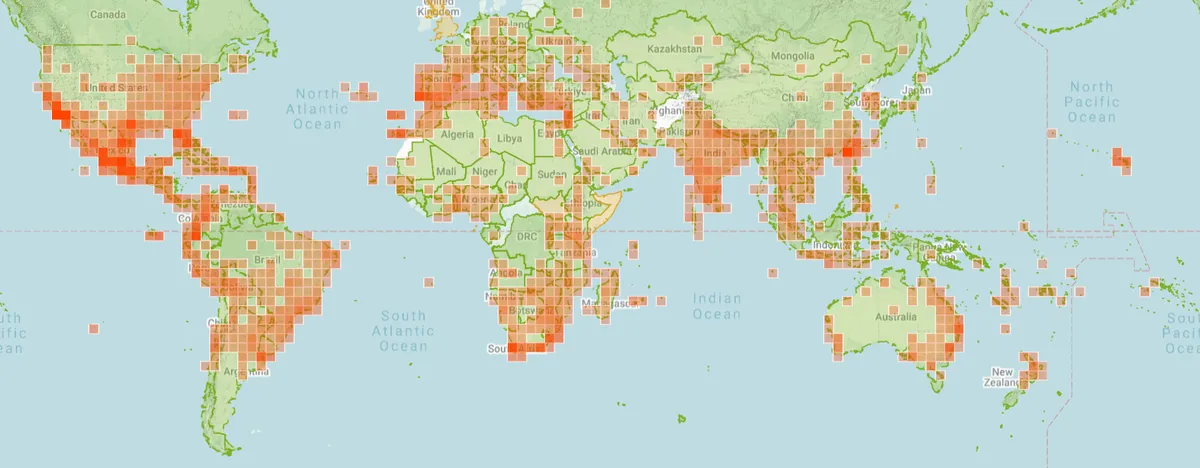
The plant is native in a bunch of those places, but it's not native to North and South America. People brought it here because it's the plant used to make castor oil.
I was first introduced to castor oil in historical children's fiction, where kids are often taking it medicinally, or being dosed with it as a punishment. I can't remember which books specifically introduced it to me, but it was like "nettles" and "public school" - a mysterious, alien cultural object present in British children's fiction but nowhere in my actual life. It turns out that it's a bad-tasting laxative. (It's also used for a bunch of other industrial and medical purposes.)
Visually, castor bean plants are extremely distinctive. Once you can spot them, they'll begin to jump out at you everywhere in your environment. You will see them on freeway embankments, behind the fence at the edge of parks, in empty lots, and in the back yards of your unsuspecting neighbors. You will recognize them from the windows of cars or trains as you fly past. They're hard to miss. After I learned to see them, I felt completely insane that I'd never noticed them before, because in empty lots, they're often the biggest thing around.
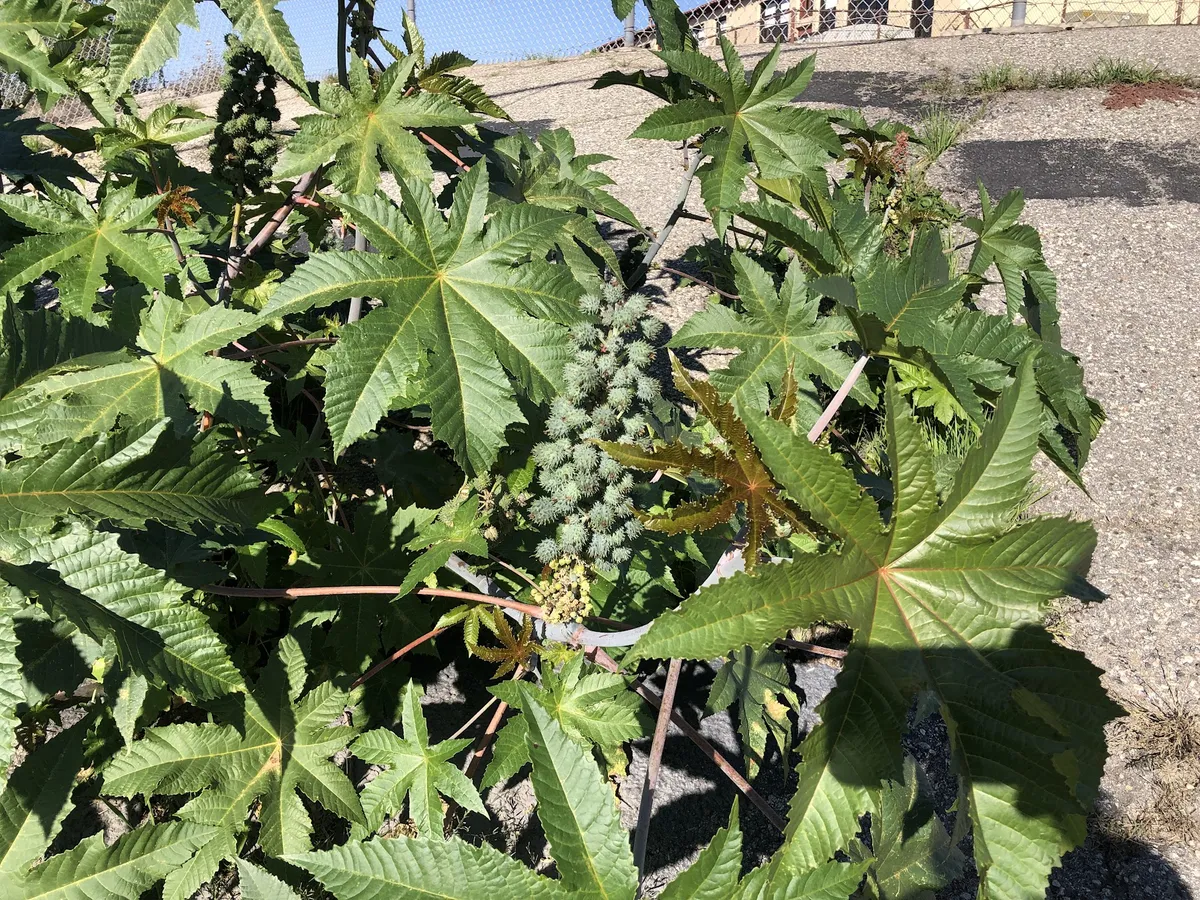
Here's a big one:
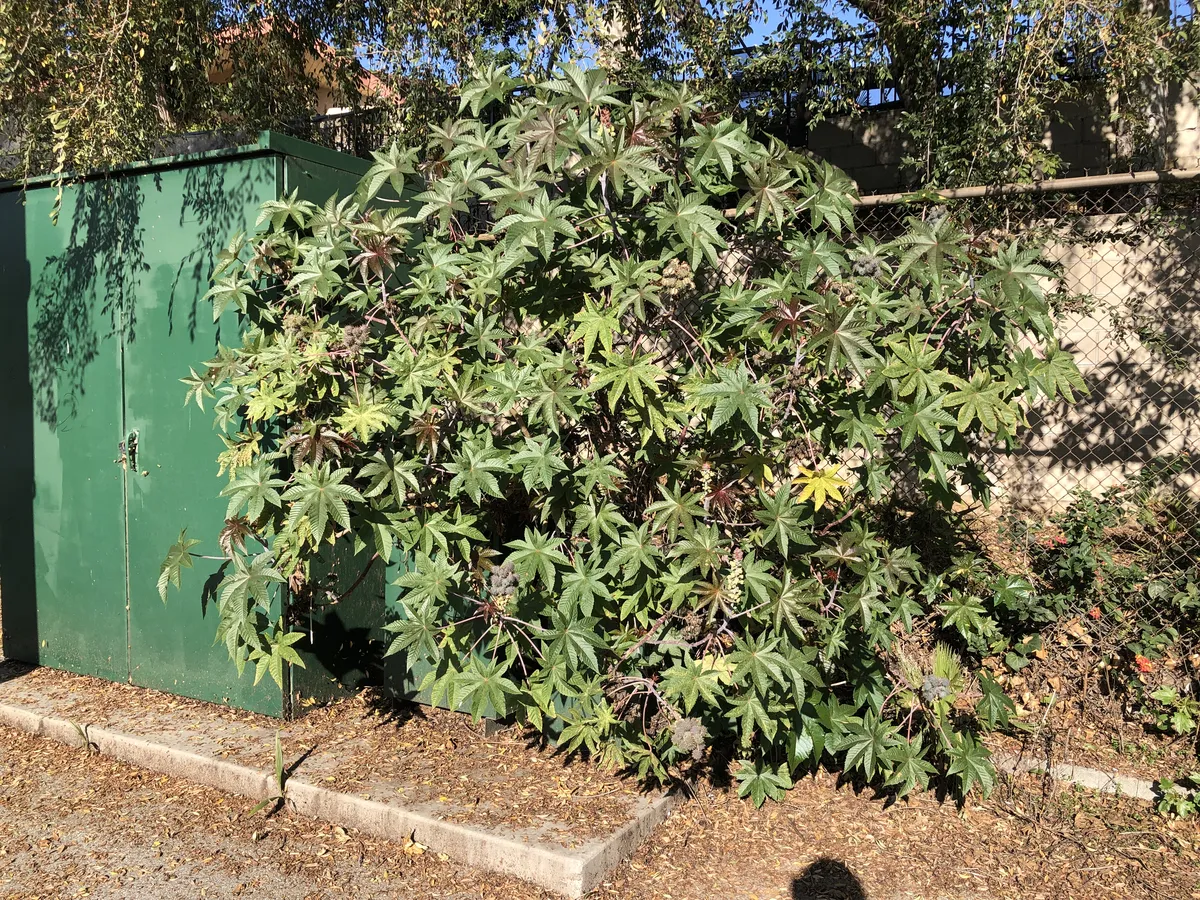
Their leaves are pretty easy to spot. They're probably hard to confuse with the leaves of any other plants growing wild near you:
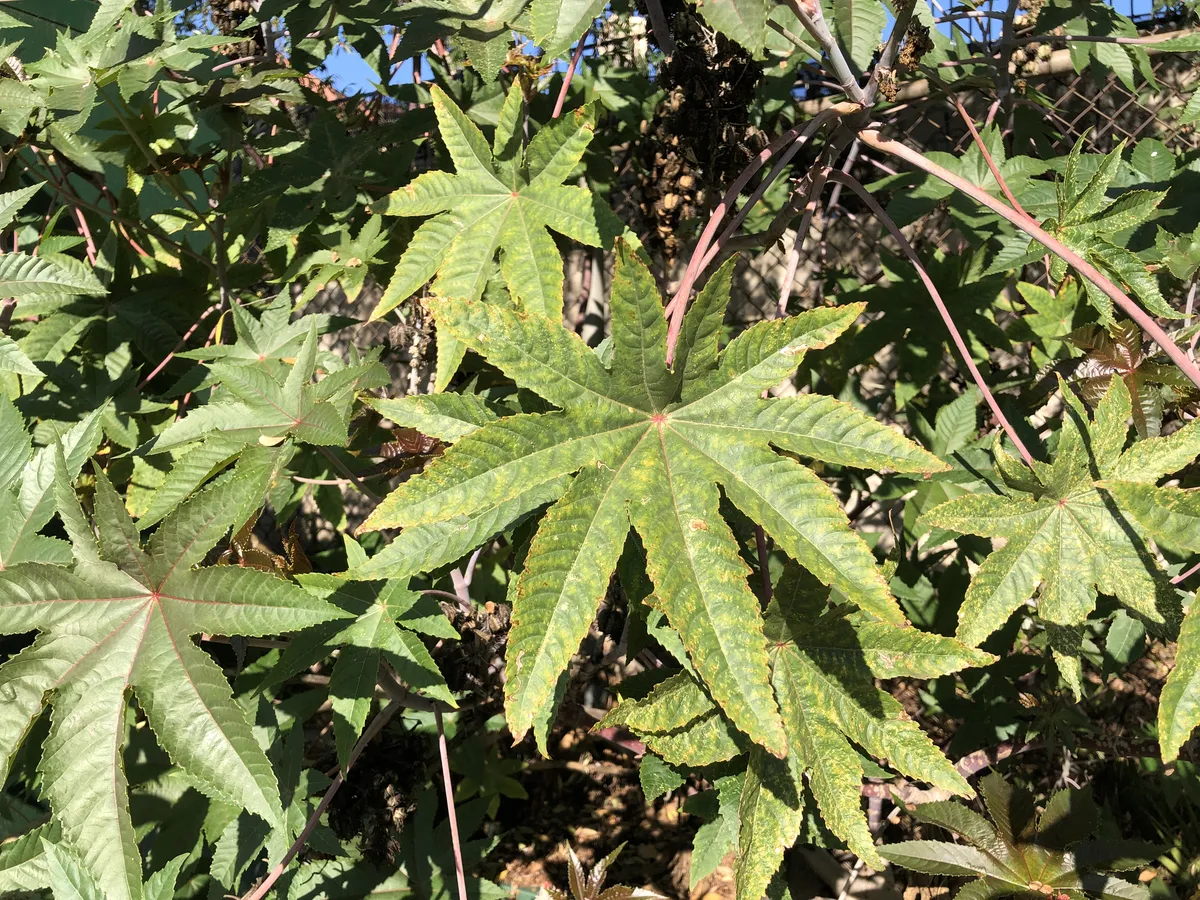
The leaves are massive - they can get a foot and a half long - and they can have anywhere between five and twelve lobes. You'll notice that the shortest lobes are close together on one side of the plant, with the longest lobes opposite the shortest ones. Here's another example of a big castor bean leaf:
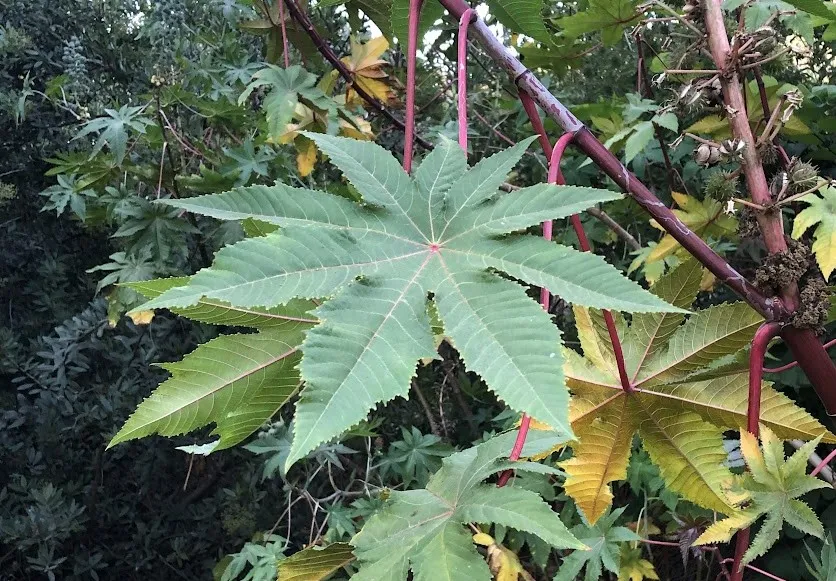
There are some tropical plants that it's possible to confuse with castor bean, but once you learn the shape of the leaves, they're pretty easy to spot. The "beans" themselves are equally distinctive:
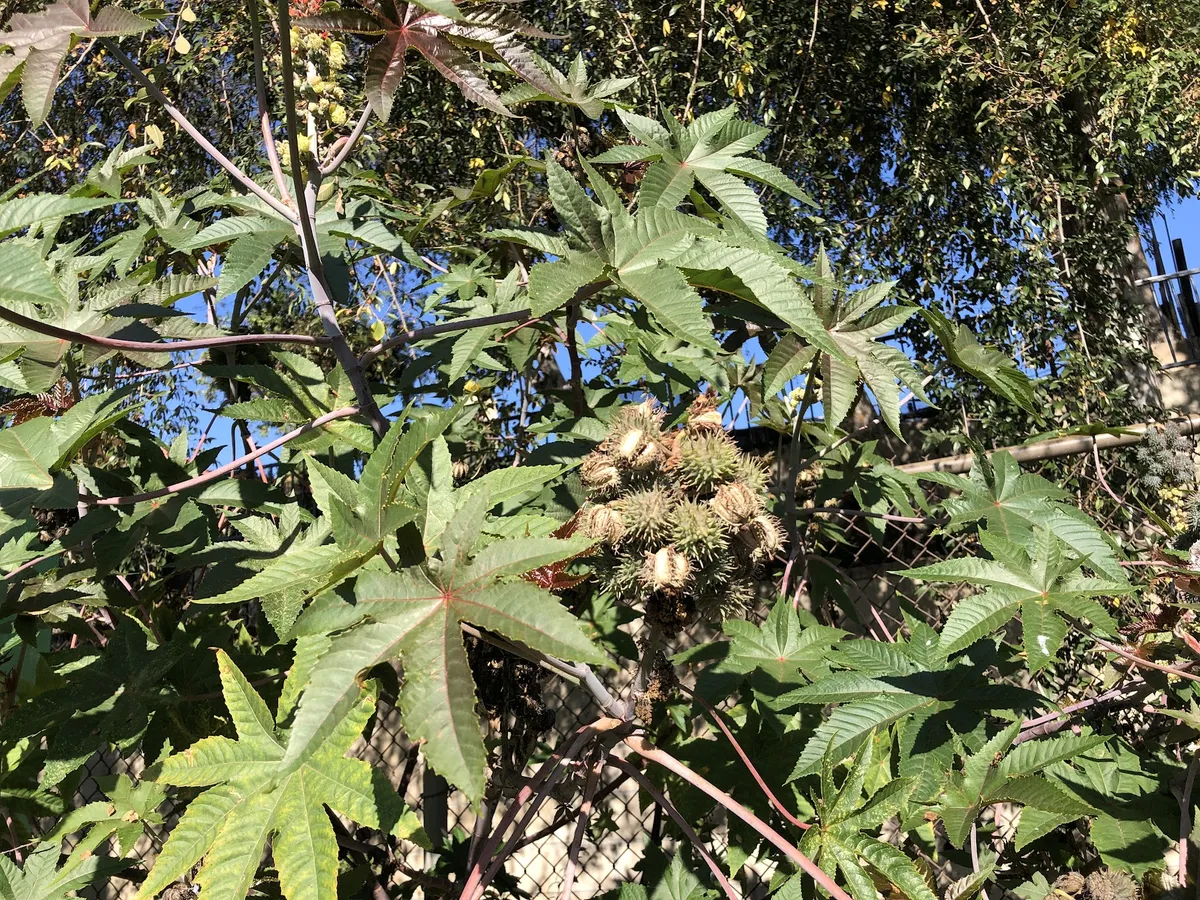
If you keep your eyes peeled, you can learn what the flowers and seed pods look like at various stages of development. They'll start out as clusters of flowers, grow into seed pods, and eventually gain that spiky cover. At some stages, the spiky cover will have little red "fingers" coming out of the far end of the seed. The seed pods might be blue, green, or even red. Eventually the casing dries up and splits to reveal the seed, like in the picture immediately above this paragraph.
Not only the seeds but the entire plant can have a variety of different colors - you can get green ones, purpley ones, different combos of leaf and stem colors, etc. You can see from my photos here that the ones around me in LA have a broad mixture of different color combinations.
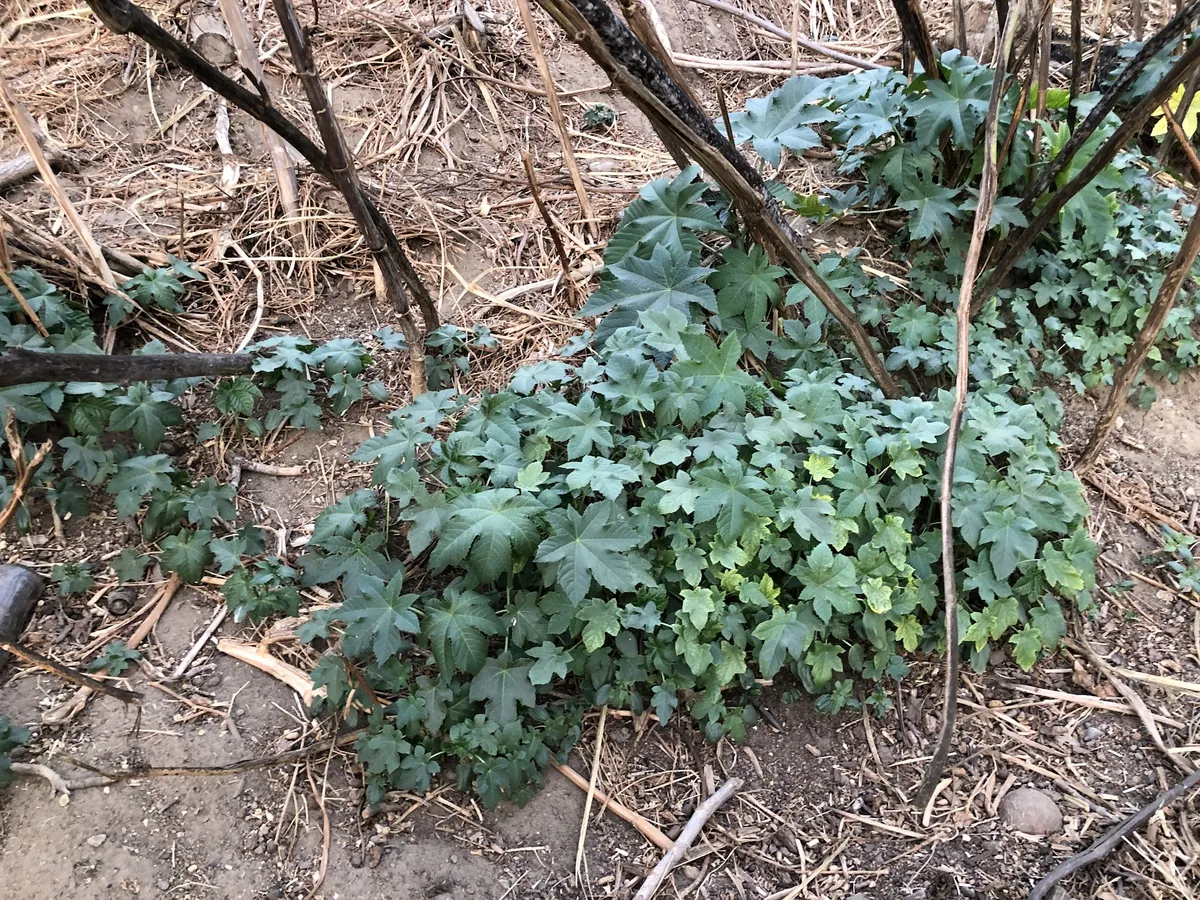
One of the reasons that castor beans are so good at being invasive is that they can sucker - they can send shoots out from the bottom of the plant. I'm pretty sure (not 100%, but pretty sure) that these are suckers, not new plants growing from seed, emerging from the bases of castor bean plants that a local park tried to clear away:
The main reason you'll see people clearing this plant is that it's invasive. Another reason you might not choose to plant it: it's extremely allergenic, and it can trigger asthma. It's also poisonous! (The poison is ricin.) However, very few people globally each year die from eating the beans. Apparently you need to eat several of the seeds to get a lethal dose, and I've been told that it hurts so much and takes so long to to kill you (in chewed-seed form, anyway) that you're very likely to just end up in the hospital, where you'll hopefully be treated. (Castor oil is not poisonous because the poison is denatured by the extraction process.)
Learning to recognize castor bean was the most effective demonstration of my, like, nature-blindness that I've ever experienced. I don't think I was ever totally unaware of the nature around me, but I didn't look at plants closely. I didn't actually examine the shape of the leaves or compare them mentally to other plants I had seen. They were just kind of sliding over my consciousness, imparting me with the feeling of plant! before my brain discarded all the specifics.
After you learn to recognize castor beans in a place where they grow invasively, it's kind of shocking how many there are all around you. Recognizing them make me ask myself, "Did I just used to be fucking stupid?? How did I not notice this big ass crazy looking plant???"
There are plenty of things that I consciously avoid noticing in the world around me. I do not keep track of the makes and models of cars, for one. I don't pay a ton of attention to the brands people are wearing. I know there are people who can "see" these things in a way that I cannot, in the same way that I can "see" the differences in the bicycles people are riding on the street, and tell that someone is riding a mountain bike vs a road bike, or whatever. But I thought I knew something about plants! I could recognize a rhododendron! I know what the different trees in New England are!!
I just wasn't looking very intentionally at many of the plants around me, I guess. There were 7-foot-high ricin-bearing bushes with 18-inch-long leaves all around me, and they simply weren't registering!