Thoughts about Knytt Classic and game difficulty
I sat down and plowed through Knytt Classic in a single sitting. While I was doing it, I had a lot of thoughts about why this game was so influential to me and others, and what it was like to be "in" the "scene" of indie game enjoyers who were talking about this game, and others like it, in the late 2000s.
I think the biggest thing I have to remind myself about games like this is that they were enjoyed primarily by people who were in a shared "scene", and that this scene was largely young people and children, and that most of us had no significant formal schooling in How To Think Or Talk About Art. So a lot of the very early brain-expanding indie games I played were influential because they demonstrated very painfully obvious artistic opportunities within games. Back then, they just weren't obvious to a lot of us kids!
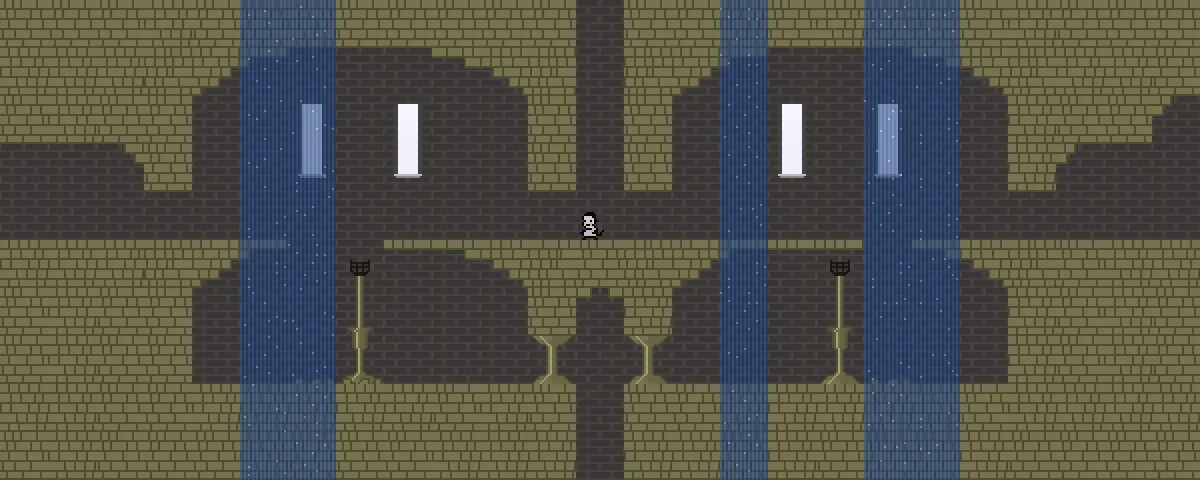
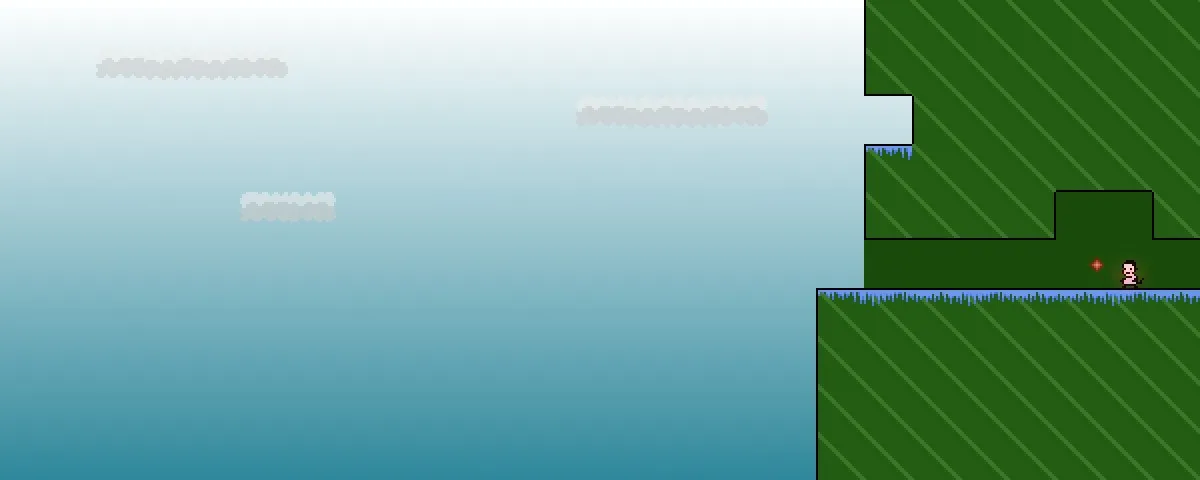
The opportunity Knytt demonstrated to me was simplicity, or minimalism - and part of its simplicity is easiness. Knytt showed me that even small and subtle and modest things said through level design and jumping mechanics and art can have a very clear, precise impact - that a screen can basically just look like this and still be really interesting:
Before playing Seiklus and Knytt, I actually avoided a lot of platforming games because I associated them with Metroid, which was too difficult for me. My parents only permitted me to play PC games, and I was pretty much only allowed to own strategy or educational games. (I only played Metroid games on my friends' Gameboys, on field trips.) I was shocked by Seiklus because I could finish it at all. Knytt shocked me, too, because it was a lot more limited, disciplined, and pared-down than Seiklus, and it showed me that a game flayed down to just level design challenges, audio, and art could still be mentally engaging and impactful without combat and without much difficulty. I hadn't ever played a platformer before which was even trying to be "soothing."
Knytt puts a red halo around your character on screens where it's possible for you to die to a hazard or an enemy. At the time, a feature like that was kind of nuts. It's there to calm you down and assure you that failure - on most screens - is impossible. I remember seeing it and realizing, "Wow! You can just do something like that!!"
"Difficulty discourse" is a cognitohazard conversation today, but back in the late 2000s it was much worse. I think the best way I can describe the mood would be to point out that "easiness in games" as a concept was, at the time, a revelation all on its own. When I played Knytt for the first time, I was most impressed by the fact that it was easy, and that easy action games can be "good," and that whether a game is mentally stimulating and "good" doesn't really have much to do with how frustrating it is.
Knytt isn't the first minimalist platformer, and it isn't the first easy one, but extremely obvious knowledge about games is constantly being re-discovered by new generations of fourteen-to-eighteen-year-olds.
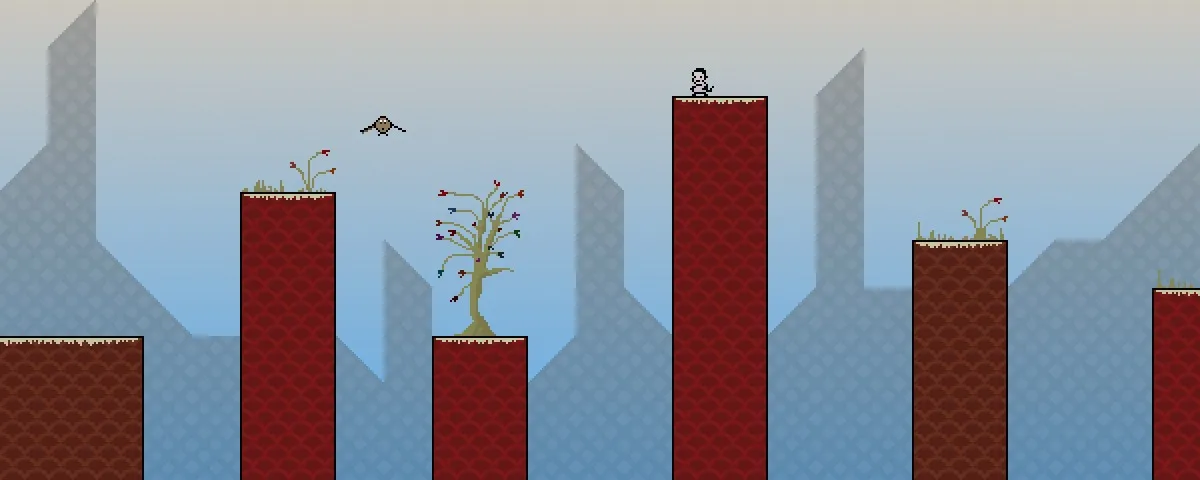
It's also worth pointing out that some people can only learn lessons about games when those lessons are communicated in "language" they can understand - including aesthetic languages. I've written about how many people aggressively avoid products which do not seem aesthetically "aimed" at them. You see this happen particularly sharply with gendered children's products.
Knytt's lessons about minimalism and difficulty were accessible to me as a teenager because the entire game did, actually, seem "aimed" at me, which was also a revelation. It wasn't particularly gendered, it was easy enough for me to complete, and it was calming and cute and simple in a way that seemed to say to me, "I am a game for you. My lessons are meant for you, specifically. I will never make you do something that makes you feel less like yourself."
I wasn't getting that same message from something like Cave Story, which made my childhood lack of pixel-art action games painfully obvious. Nor from La-Mulana or I Wanna Be The Guy, which were both far too difficult for me to complete.
It's worth pointing out that most of the games I'm talking about in this post all came out in the same few years. You can probably see why Knytt being easy was so crazy to me - all the other brand new freeware games in this genre that people were recommending me were fuck-you frustrating on purpose.
The other side of the coin, though, is that if we acknowledge that easiness has something unique to say, that making a game easy says something at all... That you can say things by making your game much easier than the other games coming out of your creative scene... Well, then we gotta admit that difficulty has the same power.
Difficulty isn't just something that you add to a game in order to exclude people, or to exude fuck-you energy. If easiness can have something interesting to say about simplicity and minimalism and relaxation, there are times when difficulty has something interesting to say about noise and complexity and maximalism and struggle. It has an artistic and rhetorical impact all of its own, and you can say things with difficulty that you cannot say with easiness, and vice versa. The games I couldn't play in 2007, like IWBTG, were saying something about difficulty too.
The fact that I believe this is one of the reasons you will never catch me participating in difficulty discourse on social media!!!
I think it's fair for some players to look with suspicion upon certain kinds of game difficulty, because not everyone is applying difficulty with care. But you gotta admit that making a game much easier or much harder than other games coming out of your community or your genre is a way of saying something about your art or yourself or your goals.
That's why I enjoyed Knytt, when it came out! It had something to say about platforming, a genre I feared and avoided and felt like I couldn't access. When I was playing Knytt, I was using my brand new income from my summer job to shatter my parents' household videogame bans. I had just bought a PS2 and a used copy of Shadow of the Colossus. I was hungry for weird vibey shit, and games that seemed to be saying something... and here was a game saying something very big, in a very small package, for free. And I could actually finish it!
So, here's the crazy thing: Knytt Classic does include two new hard modes! After finishing a sub-two-hour playthrough of the original difficulty - I'm much better at platformers now than I was in 2007 - I'm trying out "Extra-Hard mode," by Baba Is You developer Hempuli. It's basically the original game with some level changes. There's significant alterations to platforming challenges and level art, but there's also just a ton of little red hazards sprinkled all over the original levels:
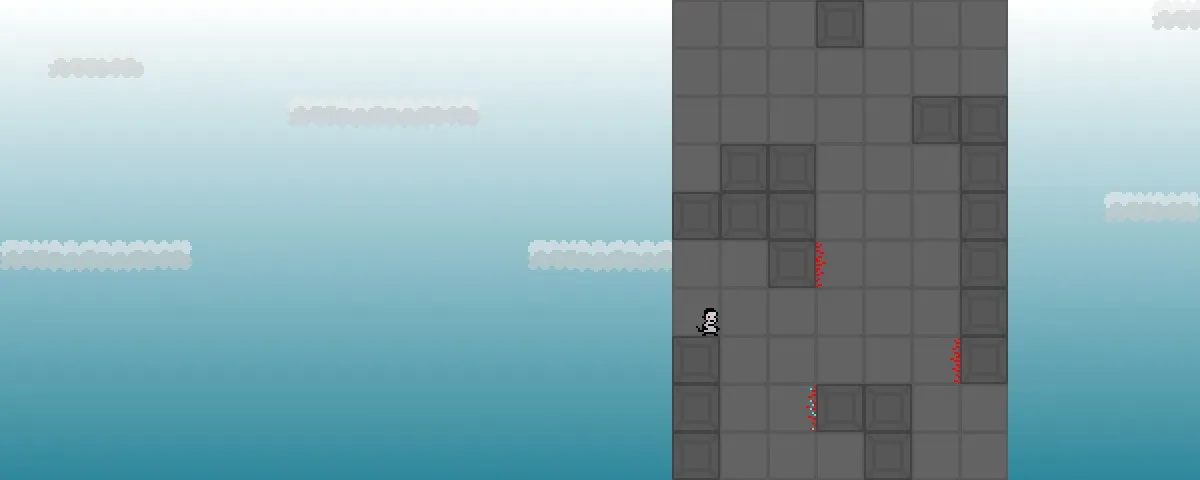
The first one I encountered is particularly funny - just a little fuck-you hazard on the way to the first, easy collectible pickup:
Touching any of these is instant death, like all the hazards in the original game.
And you know what? I don't mind it! I think adding a hard mode a cute idea!
There's a couple things going on here. I think that Knytt's platforming mechanics are really, really nice, very polished, just a delight for your fingers and your ears. There's a great pleasure to be had in mastering them. The original game doesn't contain much to test yourself against, mastery-wise - it's honestly more of an exploration and routing challenge. These new modes allow you the pleasure of actually testing your mastery of the jumping, wallclimbing, and hazard-dodging stuff that was in the original game. I think that has value.
The other thing is that Knytt no longer exists in the context of 2006 and 2007. The scene has grown - in size, and grown up - and territory which felt "new" when I was seventeen and eighteen years old doesn't feel new anymore. I think it's absolutely worth preserving as an example of a really fertile moment in games history, but new players aren't going to have the same experience with it than I did, and that's okay. Adding multiple different hard modes to a game which was notable for being calming and low-stakes and easy is actually pretty appropriate in the current moment. I think people are more likely to engage with a game like this if it has optional difficulty.
Anyway!! You should play this game! It took me less than two hours to complete the original mode. When you're done, you should also check out Knytt Stories, a game I am probably gonna sit down and play again later this week. Nostalgia is coming for me!! It's a good thing that my taste was perfect when I was a teen!!!